ABRAXAS Youth and Family Services
5701 South Wood Street, Chicago
Accepted payment: Medicaid
Accreditation from Joint Commission, per its SAMHSA report
Kinds of treatment
DetoxResidential rehabOutpatient (IOP, PHP)Medication care (MAT)Dual diagnosisAlcohol treatmentDrug treatmentGroups servedSober homesCovering rehab costsSAMHSA register, November 16, 2026
People without insurance can still get care. Sliding fees, help with payment, and money from the county, state or federal government pay for it. In this state, SAMHSA counts 488 programs.
Keep two things at hand for the call: the ZIP code and the insurance card, whether the caller's own or a family member's. A referral partner answers this paid line; programs in this directory do not.
12 of 488 listings, SAMHSA FindTreatment.gov, November 16, 2026. Most services first, then A–Z. Listing is free; a partner pays for the referral line. How we order listings.
No clear starting point? Call (217) 375-5806 A referral partner answers this paid line; programs in this directory do not.
5701 South Wood Street, Chicago
Accepted payment: Medicaid
Accreditation from Joint Commission, per its SAMHSA report
24647 North Milwaukee Avenue, Vernon Hills
Accepted payment: Medicaid · Sliding fee by income
Accreditation from Joint Commission, per its SAMHSA report
25480 West Cedarcrest Lane, Lake Villa
Accepted payment: Medicaid · Private insurance plans
Accreditation from Joint Commission, per its SAMHSA report
675 Varsity Drive, Elgin
Accepted payment: Medicaid · Private insurance plans · Sliding fee by income
101 McCausland Street, Carlinville
Accepted payment: Medicaid · Medicare · Private insurance plans
400 Mercy Lane, Aurora
Accepted payment: Medicaid · Private insurance plans
Accreditation from Joint Commission, per its SAMHSA report
1450 North County Road 2050, Carthage
Accepted payment: Medicaid · Medicare · Private insurance plans
6918 Windsor Avenue, Berwyn
Accepted payment: Medicaid · Medicare · Private insurance plans
Accreditation from CARF and Joint Commission, per its SAMHSA report
8020 West 87th Street, Hickory Hills
Accepted payment: Medicaid · Medicare · Private insurance plans
Accreditation from CARF and Joint Commission, per its SAMHSA report
1330 South Kostner Avenue, Chicago
Accepted payment: Medicaid · Medicare · Private insurance plans
Accreditation from CARF, per its SAMHSA report
1776 Moon Lake Boulevard, Hoffman Estates
Accepted payment: Medicaid · Private insurance plans · Sliding fee by income
Accreditation from Joint Commission, per its SAMHSA report
4840 West Byron Street, Chicago
Accepted payment: Medicaid · Medicare · Private insurance plans
Data from public agencies only
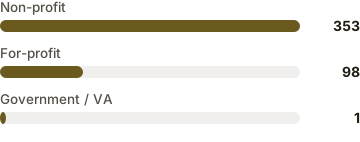
Across Illinois, 335 programs offer a sliding fee scale, 420 report public funding and 373 help with payment; that is 488 programs in total. Most cluster in Chicago (127), Joliet (13) and Peoria (10). Figures: SAMHSA locator, November 16, 2026[1].
Main points

The Illinois Department of Human Services funds substance use treatment at state-licensed providers through its Division of Behavioral Health and Recovery, using state money and the federal Substance Use Prevention, Treatment and Recovery Services Block Grant (an estimated $69.3 million for federal fiscal year 2027), plus federal State Opioid Response grants for opioid use disorder. To find substance use services, call the Illinois Helpline for Opioids and Other Substances at 833-657-7147 or text HELP to 833234; it answers 24 hours a day, 7 days a week.
Across Illinois, 335 listed programs offer a sliding fee scale, 420 have public money from the county, state or federal level for people unable to pay, and 373 help with payment. Programs that receive federal Substance Use Block Grant money have to put pregnant women and people who inject drugs at the front of the line.
412 of these programs also accept Medicaid, so for people who qualify, Medicaid coverage adds more choices. People can get the price first and then enter it into the cost calculator; the self-check points to the level of care worth asking for.


488 programs with low-cost options, sorted by level of care
Still deciding which program to ask? Call (217) 375-5806 A referral partner answers this paid line; programs in this directory do not.
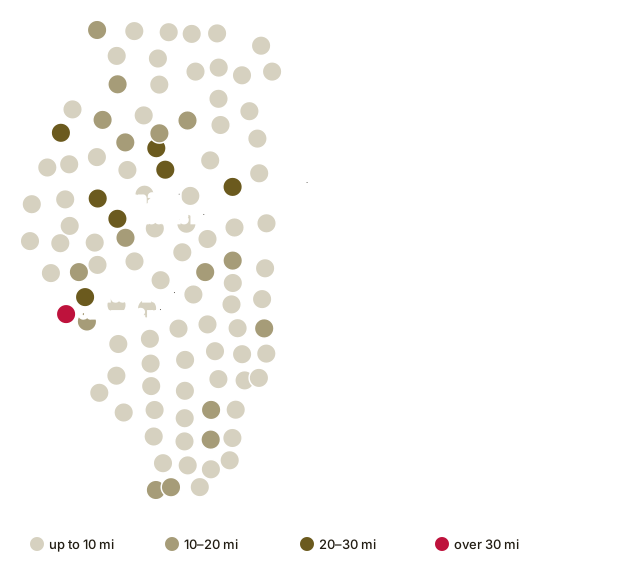
In the median county, 4.6 miles separate the center from the nearest facility on the list with low-cost options; 1 counties sit more than 30 miles out. Each distance runs in a straight line from the center point of one of the 102 counties in Illinois.
| County | Miles to the closest one |
|---|---|
| Calhoun County | 31.5 |
| Ford County | 28.2 |
| Fulton County | 26.5 |
| Greene County | 26.2 |
| Mason County | 25.5 |
| Marshall County | 22.8 |
| Mercer County | 20.0 |
| Woodford County | 20.0 |
What else do they take?
Many programs accept several kinds of payment. That helps when coverage changes partway through treatment.
Among these 488, 472 also accept cash and 335 have a sliding fee scale.
Free and confidential, 24/7. A referral partner answers this paid line; programs in this directory do not.
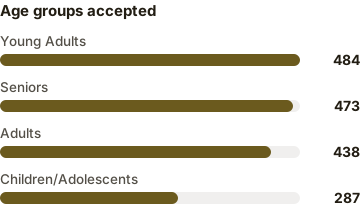
488 listings, counted by who they serve:
Out of 488 listings, the top three are Young Adults at 484, Seniors at 473 and Adults at 438.
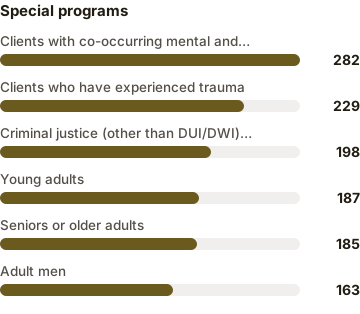
Out of 488 listings, the top three are People who have both a mental health condition and a substance use disorder at 282, Clients who have experienced trauma at 229 and Clients referred through the courts or justice system (DUI/DWI cases excluded) at 198.
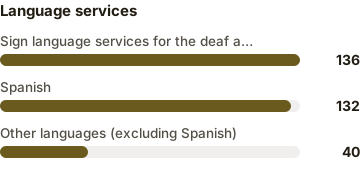
Out of 488 listings, the top three are Sign language support for clients who are deaf or hard of hearing at 136, Spanish at 132 and Other languages (excluding Spanish) at 40.
Programs report their own care settings and the help they provide once a client leaves.
Out of 488 listings, the top three are Outpatient at 445, Regular outpatient treatment at 271 and Intensive outpatient treatment at 175.

Out of 488 listings, the top three are Mentoring/peer support at 305, Housing services at 234 and Assistance with obtaining social services at 225.

Out of 488 listings, the top three are Buprenorphine used in Treatment at 152, Naltrexone used in Treatment at 146 and Methadone used in Treatment at 51.

Out of 488 listings, the top three are Cognitive behavioral therapy at 445, Telemedicine/telehealth therapy at 406 and Substance use disorder counseling at 301.

No clear starting point?
Find out which programs offer public funding or sliding fees, and what the application involves.
A referral partner answers this paid line; programs in this directory do not.
The facility counts rest on SAMHSA's snapshot dated November 16, 2026.
The Illinois Rehab editorial staff compared this page with the sources above on November 16, 2026. Our methods.
Notes on care without insurance
488 facilities out of 637 in Illinois show up on SAMHSA's locator (November 16, 2026); 86 of them have residential care and 39 have detox. Across the state, 445 programs provide outpatient care and 194 provide medication for opioid use disorder; 287 of the 488 work with teens, and 132 can serve people in Spanish. A caller who wants to know which of the 488 has room can check with the program, or reach the referral line (a paid line; a referral partner picks up).
Income and household size set the price.
After seeing proof of income (a tax return or a pay stub), the program fixes the fee. Across Illinois, 335 programs set fees on a sliding scale and 373 give payment help. Each one can say what proof of income it requires, or reach the referral line (a paid line; a referral partner picks up).
Pregnant women and people who inject drugs come first at programs that the federal Substance Use Block Grant pays for.
Everyone else usually waits for a turn, which can lead to a waiting list. 420 of the 488 receive public funding, and 412 work with Medicaid too, so a Medicaid application can widen the options.
Chicago comes first with 127, followed by Joliet (13), Peoria (10) and Elgin (9).
For Chicago, this makes up 80% of its 158 listed programs. Statewide, 188 Illinois cities have programs with low-cost options. A table on this page ranks the leading cities by their share of programs.
Of the 488, 412 take Medicaid, 382 take private insurance, 288 take Medicare, 169 take TRICARE, 472 take cash and 335 use a sliding fee scale. Further reading: Medicaid, private insurance, Medicare, TRICARE, or figure the out-of-pocket share with the cost estimate tool.
Each program above can confirm the plans it accepts, or people can call the referral line.
A referral partner answers this paid line; programs in this directory do not.
Covering rehab costs