Loretto Hospital
645 South Central Avenue, Chicago
Accepted payment: Medicaid · Medicare · Private insurance plans
Kinds of treatment
DetoxResidential rehabOutpatient (IOP, PHP)Medication care (MAT)Dual diagnosisAlcohol treatmentDrug treatmentGroups servedSober homesCovering rehab costsSAMHSA register, November 16, 2026
72% of rehab programs in Illinois take Illinois Medicaid. In this state, SAMHSA counts 460 programs.
Keep two things at hand for the call: the ZIP code and the insurance card, whether the caller's own or a family member's. A referral partner answers this paid line; programs in this directory do not.
12 of 460 listings, SAMHSA FindTreatment.gov, November 16, 2026. Most services first, then A–Z. Listing is free; a partner pays for the referral line. How we order listings.
No clear starting point? Call (217) 375-5806 A referral partner answers this paid line; programs in this directory do not.
645 South Central Avenue, Chicago
Accepted payment: Medicaid · Medicare · Private insurance plans
2409 North Clybourn Avenue, Chicago
Accepted payment: Medicaid · Medicare · Private insurance plans
3306 West 63rd Street, Chicago
Accepted payment: Medicaid · Medicare · Private insurance plans
6303 North Clark Street, Chicago
Accepted payment: Medicaid · Medicare · Private insurance plans
209 West Romeo B Garrett Avenue, Peoria
Accepted payment: Medicaid · Private insurance plans · Sliding fee by income
Accreditation from CARF, per its SAMHSA report
9718 South Halsted Street, Chicago
Accepted payment: Medicaid · Medicare · Private insurance plans
3535 Mayflower Boulevard, Springfield
Accepted payment: Medicaid · Private insurance plans · Sliding fee by income
Accreditation from CARF, per its SAMHSA report
600 West Lincoln Avenue, Caseyville
Accepted payment: Medicaid · Private insurance plans · Sliding fee by income
Accreditation from Joint Commission, per its SAMHSA report
524 West Stephenson Lane, Freeport
Accepted payment: Medicaid · Medicare · Private insurance plans
Accreditation from Joint Commission, per its SAMHSA report
932 West Washington Boulevard, Chicago
Accepted payment: Medicaid · Medicare · Private insurance plans
Accreditation from CARF, per its SAMHSA report
2323 Stevenson Drive, Springfield
Accepted payment: Medicaid · Medicare · Private insurance plans
Accreditation from Joint Commission, per its SAMHSA report
1706 North Kedzie Avenue, Chicago
Accepted payment: Medicaid · Medicare · Private insurance plans
Data from public agencies only
Across Illinois, 460 of the 637 programs on the list accept Medicaid; among them are 74 residential programs and 36 detox units. The largest groups sit in Chicago (125), Peoria (10) and Elgin (8). Figures: SAMHSA locator, November 16, 2026[1].
Main points

Illinois expanded Medicaid under the Affordable Care Act, so adults 19 to 64 with income up to 138% of the federal poverty level can qualify. Illinois Medicaid, run by the Department of Healthcare and Family Services (HFS), covers mental health and substance use disorder services, and a federal 1115 waiver first approved in 2018 lets it pay for residential and inpatient addiction treatment. Medicaid work requirements for ACA adults start in 2027, but people taking part in a drug or alcohol treatment program are exempt.
Medicaid sends payment straight to the program, so people get no bill at the start. Where Illinois Medicaid sets copays, federal rules hold them to small amounts. Many states route Medicaid through managed care plans, so a program may sit in one plan's network and outside another's.
36 detox units and 199 programs giving medicine for opioid use in the state accept Medicaid. For people not yet enrolled, many programs help with the application, and programs backed by public money can begin care while the application moves forward.


460 programs accepting Medicaid, sorted by level of care
Still deciding which program to ask? Call (217) 375-5806 A referral partner answers this paid line; programs in this directory do not.
In the median county, 4.8 miles separate the center from the nearest facility on the list accepting Medicaid; 1 counties sit more than 30 miles out. Each distance runs in a straight line from the center point of one of the 102 counties in Illinois.
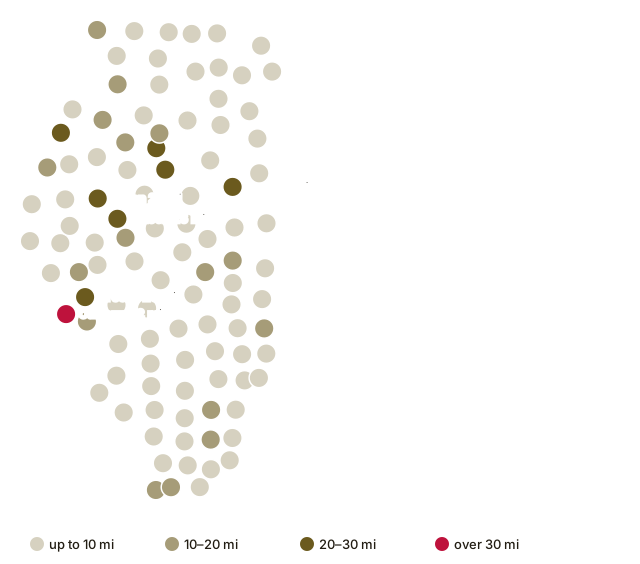
| County | Miles to the closest one |
|---|---|
| Calhoun County | 31.5 |
| Ford County | 28.2 |
| Greene County | 26.2 |
| Mason County | 25.5 |
| Fulton County | 24.3 |
| Marshall County | 22.9 |
| Woodford County | 20.3 |
| Mercer County | 20.0 |
What else do they take?
Many programs accept several kinds of payment. That helps when coverage changes partway through treatment.
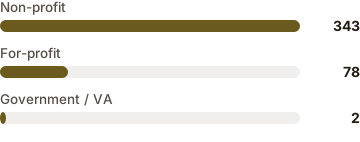
Among these 460, 445 also accept cash and 283 have a sliding fee scale.
Free and confidential, 24/7. A referral partner answers this paid line; programs in this directory do not.
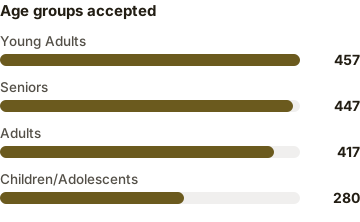
460 listings, counted by who they serve:
Out of 460 listings, the top three are Young Adults at 457, Seniors at 447 and Adults at 417.
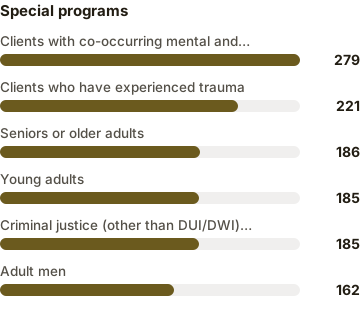
Out of 460 listings, the top three are People who have both a mental health condition and a substance use disorder at 279, Clients who have experienced trauma at 221 and Seniors or older adults at 186.
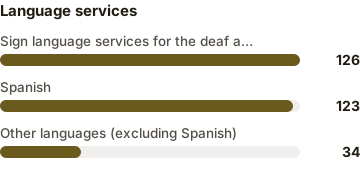
Out of 460 listings, the top three are Sign language support for clients who are deaf or hard of hearing at 126, Spanish at 123 and Other languages (excluding Spanish) at 34.
Programs report their own care settings and the help they provide once a client leaves.
Out of 460 listings, the top three are Outpatient at 427, Regular outpatient treatment at 246 and Intensive outpatient treatment at 160.

Out of 460 listings, the top three are Mentoring/peer support at 288, Assistance with obtaining social services at 221 and Housing services at 218.

Out of 460 listings, the top three are Buprenorphine used in Treatment at 149, Naltrexone used in Treatment at 137 and Methadone used in Treatment at 62.

Out of 460 listings, the top three are Cognitive behavioral therapy at 428, Telemedicine/telehealth therapy at 392 and Substance use disorder counseling at 266.

No clear starting point?
Confirm with every program that it bills the person's Medicaid plan.
A referral partner answers this paid line; programs in this directory do not.
The facility counts rest on SAMHSA's snapshot dated November 16, 2026.
The Illinois Rehab editorial staff compared this page with the sources above on November 16, 2026. Our methods.
Notes on Medicaid
460 facilities out of 637 in Illinois show up on SAMHSA's locator (November 16, 2026); 74 of them have residential care and 36 have detox. Across the state, 427 programs provide outpatient care and 199 provide medication for opioid use disorder; 280 of the 460 work with teens, and 123 can serve people in Spanish. A caller who wants to know which of the 460 has room can check with the program, or reach the referral line (a paid line; a referral partner picks up).
Not every time.
In states where managed care plans run Medicaid, a program contracts with some of those plans and not with the rest. So people should give the program the plan's name, not only the word Medicaid. Across Illinois, Medicaid appears at 460 programs; each bills a different set of Illinois Medicaid plans, so a caller can check which ones, or reach the referral line (a paid line; a referral partner picks up).
Check with the program.
389 of these programs list public funding for people who cannot cover the cost, and many also help people apply. Among the 460 programs that take Illinois Medicaid, 283 also have a sliding fee scale and 316 give payment assistance, which can fill the gap while the application is still pending.
Chicago comes first with 125, followed by Peoria (10), Elgin (8) and Joliet (7).
For Chicago, this makes up 79% of its 158 listed programs. Statewide, 186 Illinois cities have programs accepting Medicaid. A table on this page ranks the leading cities by their share of programs.
Of the 460, 376 take private insurance, 303 take Medicare, 169 take TRICARE, 445 take cash, 283 use a sliding fee scale and 389 report public funding. Further reading: private insurance, Medicare, TRICARE, no insurance, or figure the out-of-pocket share with the cost estimate tool.
Each program above can confirm the plans it accepts, or people can call the referral line.
A referral partner answers this paid line; programs in this directory do not.
Covering rehab costs